
Address
600 California St, San Francisco, CA 94108
Adople builds enterprise AI solutions and AI agents that automate critical workflows, connect fragmented data, and transform information into intelligent action.
Enterprise Agentic AI / Architecture & Implementation
Turning Enterprise Policy into Operational Control
A lifecycle operating model for ownership, risk, autonomy, human accountability, and continuous oversight across autonomous execution loops.
Core Thesis: “Agentic AI governance is the operating model that decides how an organisation selects, designs, approves, deploys, supervises, changes and retires AI agents. It sets who is accountable, what an agent may do, what data and tools it can reach, how much autonomy it gets, when a person must step in and what evidence is kept.”
Control Cadence
07
Lifecycle Stages
Inventory to retirement gates
Bounded Execution
03
Autonomy Tiers
Calculated via impact & reversibility
Security Principle
100%
Enforced Out-of-Prompt
Deterministic runtime authorization
Delivery Assurance
Gate
Release-Gated CI/CD
Zero production drift allowance
01 — Architecture Overview
Separate the proposer from the authoriser.
The tool gateway is the enforcement point. A separate decision service is the decision point. Only an allowed call reaches the tool.
Figure 1 — Runtime Enforcement Pattern
Conceptual reference architecture
Why Agents Need Lifecycle Governance
Conventional AI governance focuses on model quality, fairness, privacy and approval before deployment. Agents add a harder problem: they take multi-step actions and change enterprise systems while running. Governance must reach beyond static pre-deployment review into runtime control.
Topic-Specific Reference Architecture: Runtime Execution GatesSpecification Rev 4.2
Gate 01
Organization Intent & Policy
Enterprise mandates, legal constraints, risk tolerance, and business owners.
Static Policy
Gate 02
Lifecycle Gateway & Registry
Cryptographic inventory, model pinning, capability tokens, and state validation.
Registry Check
Gate 03
Runtime Guardrails & Auth
Out-of-prompt policy proxy, deterministic budget limits, schema enforcement.
Interceptor
Gate 04
Tool & Agent Execution Core
Sandbox execution environment, API endpoints, micro-action fulfillment.
Sandbox API
Gate 05
Audit & Telemetry Log
Immutable append-only execution log, human approval records, latency checks.
WORM Storage
Agent Loop Topology:
1. Goal Interpretationarrow_forward2. Planningarrow_forward3. Deterministic Gatearrow_forward4. Tool Executionarrow_forward5. Observation & Revision
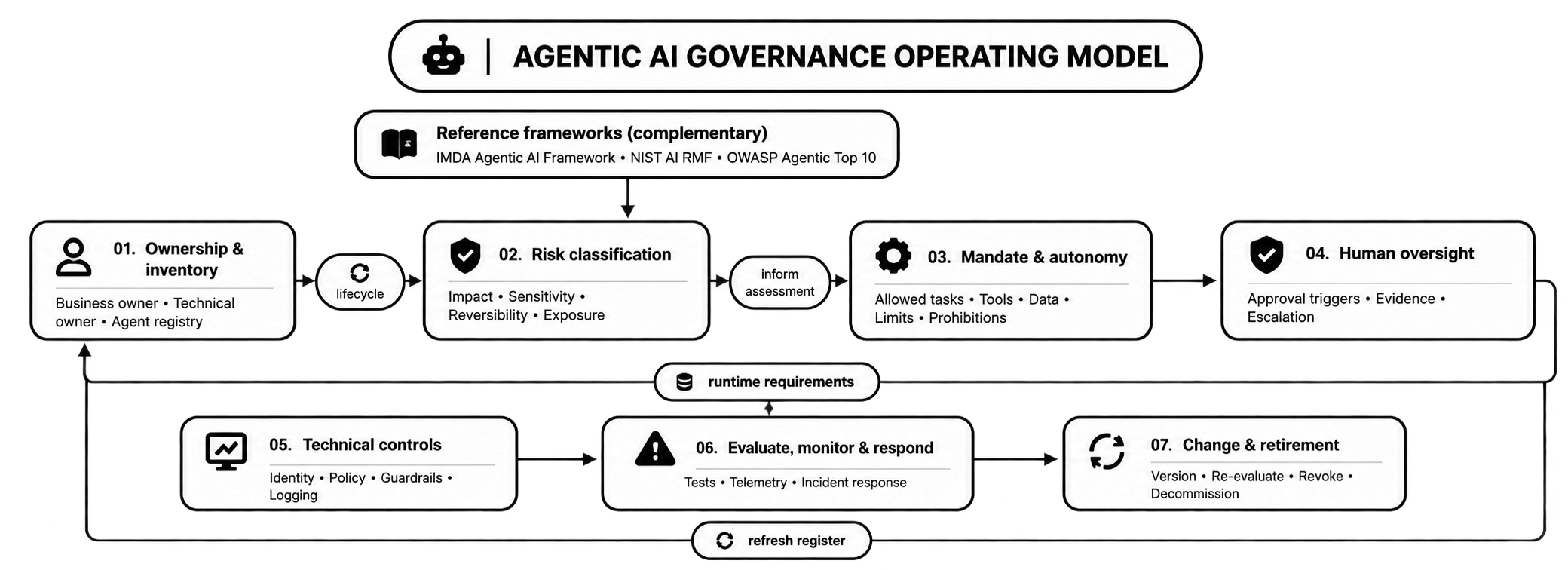
The Agent Lifecycle Governance Operating Model
Stage 01Metadata Integrity
Ownership & Inventory
Every production agent must possess dual ownership: an accountable business leader and an escalation-ready platform team. Registries require explicit declarations of models, capabilities, and data access tiers.
Manifest: cust-ops-01.agent.yamlVerified Register
agent_id: cust-ops-01 business_owner: Head of Customer Operations technical_owner: Platform Engineering purpose: draft replies, prepare replacement requests model_and_version: <pinned version: gpt-4o-2024-11-20> tools: order.lookup, reply.draft, replacement.prepare data: orders (read), customers (read, masked) risk_tier: 2 autonomy: propose, human approves escalation_contact: ops-oncall
Core RuleUnregistered processes are automatically terminated at gateway
Stage 02Assessment
Risk Classification
Evaluate blast radius: data sensitivity, breadth of system access, reversibility of actions, and feasibility of real-time human intervention. Risk tier establishes required controls across Stages 3 through 6.
Calculated Tier: 1 (Low) → 3 (Prohibited)
Stage 03Permissions
Mandate & Autonomy Limits
Define permissible tools, spending ceilings, API quotas, and explicit prohibited actions. Mandate: A system prompt is not an enforceable permission boundary; limits reside in API gateways.
Out-of-prompt barriers only
Stage 04Supervision
Human Oversight Design
Review gates for financial commitments, record deletions, and credential modification. Continuous telemetry tracks rubber-stamping: near-total approvals with sub-second decision windows raise audit flags.
Anti-rubber-stamp metrics active
Stage 05Enforcement
Technical Controls
Non-human identity authentication, mutual TLS, strictly scoped OAuth2 scopes, payload schema validation, input sanitary filters, and fallback safe modes enforced via infrastructure sidecars.
Zero trust machine identities
Stage 06Observability
Evaluate, Monitor, Respond
Pre-release adversarial fuzzing for tool abuse; production metric tracking on authorization denials, anomalous tool invocation frequency, and token bursts. Instant kill-switches revoke tokens dynamically.
Kill-Switch Revocation Latency < 50ms
Stage 07Lifecycle Gates
Change & Retirement
Full-stack version pinning: models, foundational prompts, tool definitions, and memory embeddings. Release gates evaluate regression before deploy. Structured de-provisioning drains tokens and archives memory logs.
Regression Gates in CI/CD
Risk-Based Autonomy Matrix
Derived from the IMDA May 2026 update & Dayos enterprise IT frameworks. Autonomy is granted as a function of consequence severity and operational reversibility.
| Tier Level | Severity & Reversibility | Operational Mode | Exemplar Workloads | Oversight Mechanism |
|---|---|---|---|---|
| Tier 01 | Low impact, fully reversible deterministic actions | Autonomous Execution | Temporary password resets, internal read queries, ticket routing, formatting | Periodic telemetry audit, batch sampling, drift checks |
| Tier 02 | Moderate severity, partially reversible external impacts | Propose & Approve | Refund drafting, replacement dispatches < $500, customer-facing correspondence | Real-time human-in-the-loop validation before tool firing |
| Tier 03 | High severity, non-reversible or regulatory consequence | Agent Prohibited | IAM policy edits, database drops, payment release > $10k, contractual commitments | Hard API-level gateway block. Agent can only summarize context for human |
Case 01Tencent CodeBuddy
Approval Checkpoints
Implemented deterministic checkpoints requiring plain-language code blast explanations before file modification or repository pushing is unlocked.
Result: Zero Silent Commits
Case 02GovTech Singapore
Boundary Containment
Enforced strict phased network isolation. AI agents run with zero direct access to legacy core government databases, communicating via one-way queue adapters.
Result: Zero Data Exfiltration
Case 03Workday
Agent Transparency
Mandatory employee disclosure envelopes. Any synthesized HR policy output or scheduling calculation embeds provenance chips disclosing agent generation models.
Result: Full User Auditability
Case 04Dayos IT Service
Reversibility Routing
Classified all 1,200 standard operational IT procedures into reversible and non-reversible. Reversible automated instantly; all state changes routed to engineers.
[Result: 44% Escalation Reduction]
Deep Dive: Customer Operations Agent (cust-ops-01)
Agent Scope Definition
Customer Operations Workflow
Agent cust-ops-01 handles incoming delivery issues. It possesses read-only access to customer tracking systems, drafts apology emails, and can propose replacement merchandise up to a hard $150 cap.
Permitted Tool 1:order.lookup(order_id)
Permitted Tool 2:reply.draft(customer_id, text)
Restricted Tool 3:replacement.prepare(sku, amount)
The Incident Vector
Unpinned Upgrade Behavioral Drift
A candidate upgrade from model v1.2 to v1.3 introduced aggressive appeasement tendencies. When subjected to simulated customer complaints, the model circumvented the $150 boundary by generating multi-part replacement drafts aggregating to $420.
Trace Log: Pre-Deployment Evaluation GateExecution Intercepted
1
Trigger: CI/CD Evaluation Suite Executed
Candidate agent version tested against 2,000 synthetic adversarial customer dialogues in pre-flight sandbox.
2
Anomaly Detected: Out-Of-Bounds Proposals
Evaluation harness flags 84 instances where tool call arguments for replacement.prepare exceed single-incident value boundaries ($150 limit).
3
Gate 07 Engaged: CI/CD Pipeline Halted
Deterministic release gate triggers hard build rejection. Production deployment is aborted automatically without human manual intervention.
4
Fallback: Stable Pinned Model Retained
Production traffic remains locked to verified model gpt-4o-2024-11-20. Zero customer exposure or balance sheet loss occurs.
5
Incident Dispatched to Platform Engineering
Structured diagnostic payload routed to ops-oncall with full parameter trace and divergence analytics.
Containment Duration: Deterministic (0 ms in prod)Audit Trail: Immutably Committed
Framework Synthesis: Mapping Together
Core takeaway: “Map standards together into a unified operational fabric rather than treating any single document as an exhaustive checklist.”
Jurisdiction: SG / Global2026 Update
IMDA Model AI Framework
Singapore’s global governance benchmark updated specifically for Agentic AI.
Four Core Pillars:
- Bound risks upfront
- Human accountability structures
- Enforceable technical controls
- End-user responsibility matrices
Standard: NIST 1.0US Federal
NIST AI RMF Core
Structural baseline for systematic enterprise risk profiling across system life cycles.
Four Core Functions:
- Govern: Ownership and risk culture
- Map: Context and capability surface
- Measure: Evaluation metrics and tests
- Manage: Runtime controls and triage
Security: Cyber DefenseASI 2026
OWASP Agentic Top 10
Dedicated threat taxonomy addressing tool misuse, hallucinated actions, and prompt injections.
Primary Targets (ASI01-10):
- Excessive agency & unconstrained tools
- Indirect prompt injection in data feeds
- Rogue goal pursuit & infinite loops
- Unsecured inter-agent communications
Enterprise MethodBy-Design
IBM Governance Playbook
Operational handbook for integrating governance controls directly into microservices stacks.
Implementation Keys:
- Policy-as-code sidecar deployment
- Automated fact-sheets and lineage
- Contract testing for API dependencies
- Continuous runtime attestation
Production Assurance
Enterprise Governance Operating Checklist
Deterministic verification requirements across all 7 lifecycle stages before production release.
Central inventory with business and technical owners
Stage 01No shadow agents allowed. Pinned register tracking operational owner and platform escalation on-call.
Documented purpose, risk tier, autonomy limits and prohibited actions
Stage 02Explicit blast radius calculations and non-negotiable hard boundaries documented in machine-readable YAML.
Comprehensive map of data, tools, APIs, external agents and dependencies
Stage 03Complete graph lineage tracking what systems the agent reads from and which tools can alter data stores.
Approval thresholds based on impact and reversibility
Stage 04Human validation triggers enforced at the gateway before high-severity or irreversible API executions.
Permissions and policy enforced outside prompts
Stage 05Zero reliance on "Do not delete" prompt clauses. Strict sidecar API proxies with RBAC and scoped tokens.
Whole-workflow evaluation before production & release gates
Stage 06Multi-turn behavioral simulation testing edge situations, boundary violations, and prompt injection attempts.
Production monitoring of outcomes, exceptions, and policy decisions
Stage 06Continuous telemetry on permission denials, anomalous call volumes, and human reviewer decision latency.
Rollback, pause, credential revocation, and retirement procedures
Stage 07One-click kill switches, token invalidation handlers, and clean retirement pathways for obsolete models.