

Why This Matters: A Real Milestone and a Common Overstatement
In December 2024, Google reported that its Willow chip completed a benchmark computation in under five minutes. Google estimated that one of today’s fastest supercomputers would need about 10 septillion (10^25) years for the same task. Google also stated its own caveats. The estimate rests on conservative assumptions, classical methods will keep improving, and the benchmark has no known practical application.
The result is a real engineering milestone. It is not evidence that quantum computers are about to outperform classical ones on everyday workloads. The rest of this page separates what has been shown from what has been claimed.
The Computational Model
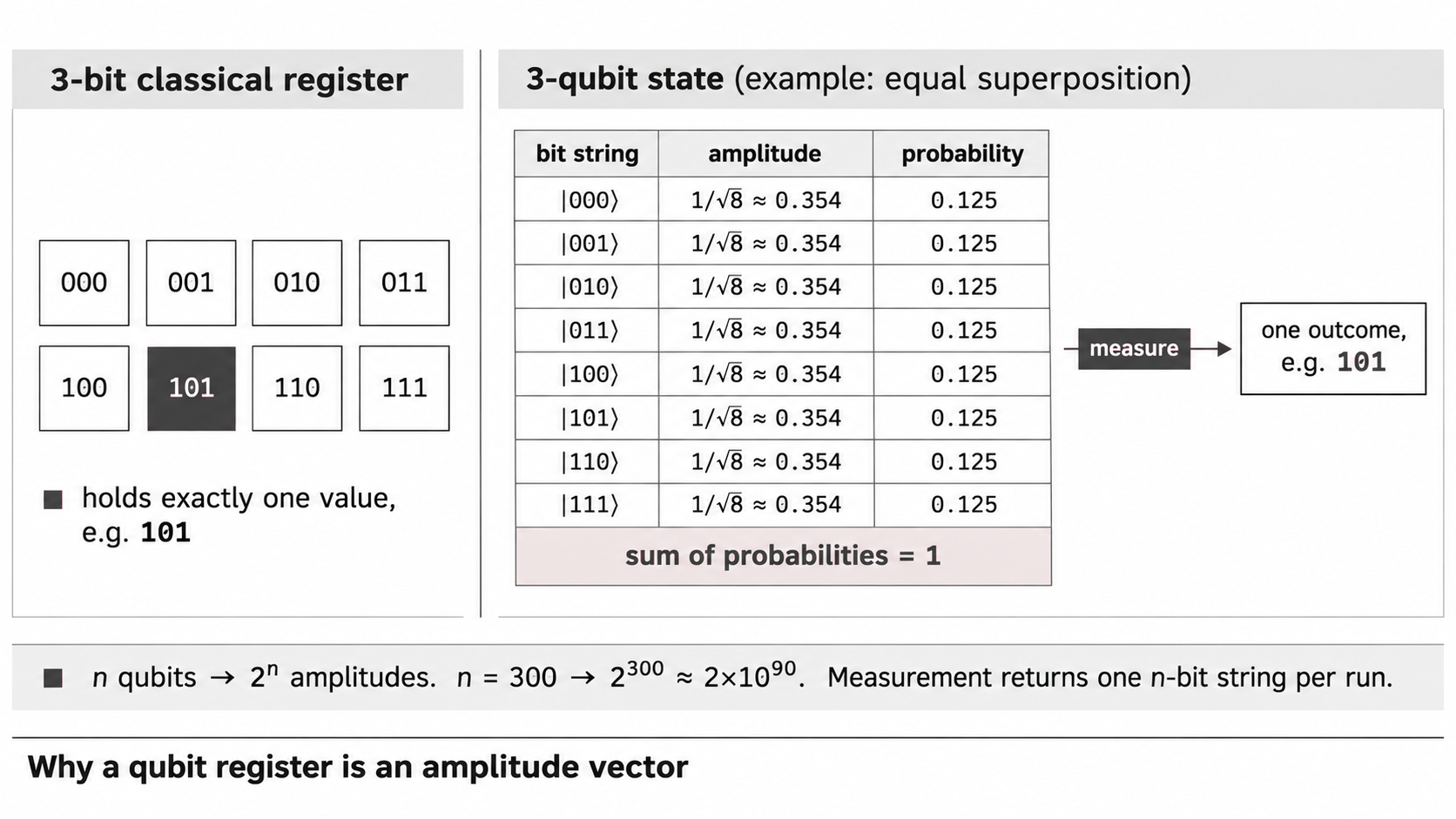
A classical register of n bits holds exactly one of 2^n values at a time. A register of n qubits is described by 2^n complex numbers, called amplitudes, one for each possible bit string. The probability of measuring a given bit string is the squared magnitude of its amplitude, and the probabilities sum to 1.
Two consequences follow:
Measurement returns one outcome. Reading the register collapses it to a single n-bit string. The 2^n amplitudes are never read out directly. Algorithms repeat the run many times (called shots) and look at the distribution of results.
The size is large but not free. With 300 qubits, 2^300 is about 2×10^90, far more than the roughly 10^80 atoms usually cited for the observable universe. A classical machine cannot store that many amplitudes, and a quantum machine does not store them explicitly. It evolves them physically. But because measurement returns only one string, quantum computing is not “try every answer at once and read the right one.”
The skill in quantum algorithm design is to arrange the amplitudes so that, at measurement time, the correct answer is overwhelmingly likely.
Three Properties and How They Work Together
Superposition. A qubit’s state is a combination of the two basis states with amplitudes for each. By itself, superposition is not useful. Measuring a uniform superposition just returns a random bit string.
Entanglement. Entangled qubits have correlated states that cannot be described as independent parts. The standard example is a Bell state, built with a Hadamard (H) gate on one qubit followed by a controlled-NOT (CNOT) gate. Measuring either qubit gives a random result, but the two results always agree.
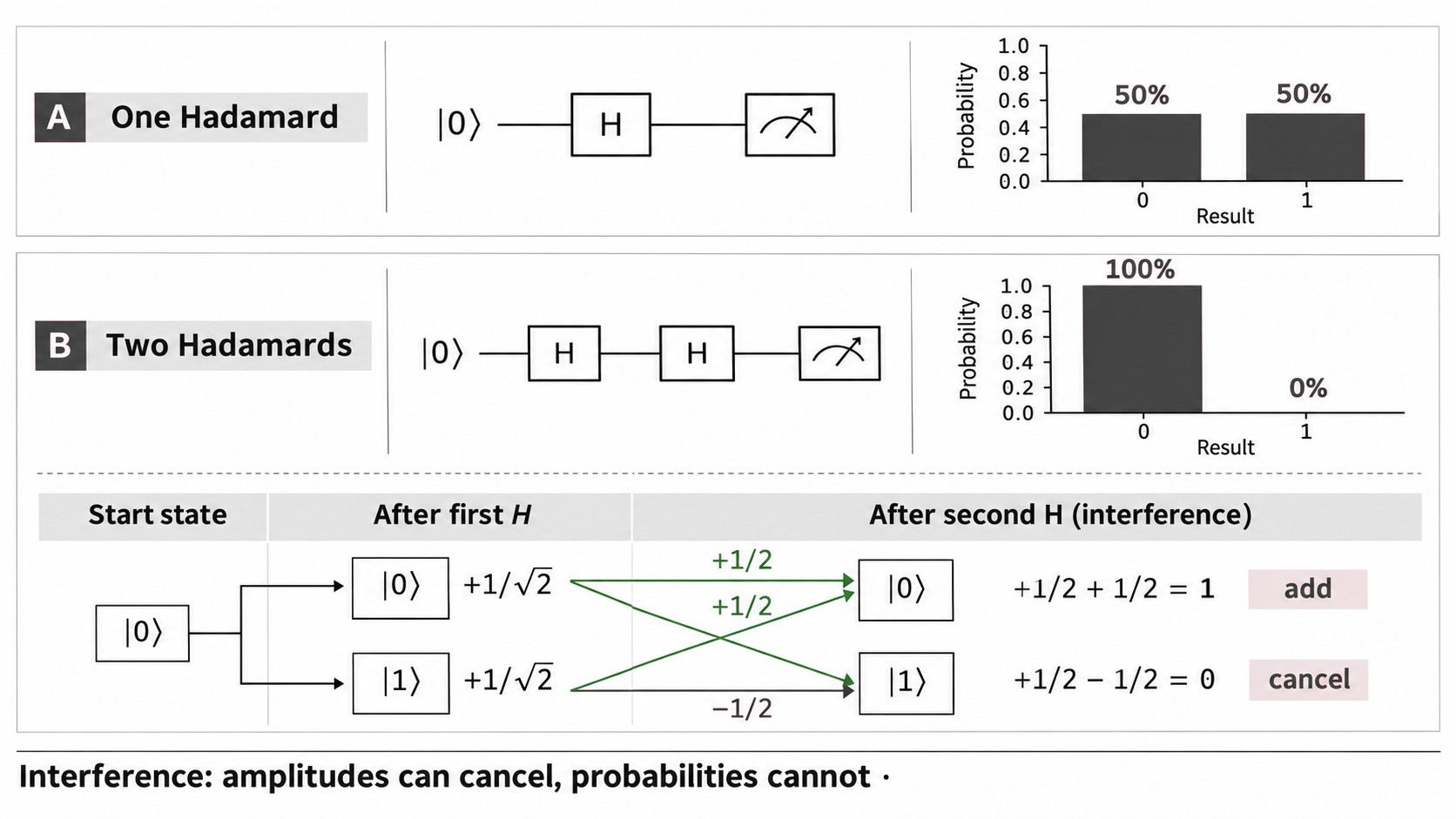
Interference. This is what makes algorithms work. Because amplitudes can be positive or negative, a circuit can make the amplitudes of wrong answers cancel and those of correct answers add up. Probabilities cannot cancel this way, which is why “a qubit is a probability distribution” is a misleading summary.
A minimal demonstration of interference: apply H to a qubit starting in state 0, and measuring gives 0 or 1 with equal probability. Apply H a second time and the result is 0 with certainty. The two paths leading to outcome 1 carry amplitudes of opposite sign and cancel, and the two paths leading to outcome 0 add.
| Step | Operation | Result |
|---|---|---|
| Initial state | Qubit starts in 0 | 0 |
| First operation | Apply H | Equal probability of 0 or 1 |
| Second operation | Apply H again | 0 with certainty |
What Quantum Computers Are Fast At
The speedup is structural: it exists only for problems with the right mathematical shape.
| Problem class | Status |
|---|---|
| Factoring integers (Shor’s algorithm) | Exponential speedup over the best known classical algorithms. This is the basis of the cryptographic threat. |
| Unstructured search (Grover’s algorithm) | Quadratic speedup. |
| Simulating quantum systems (molecules, materials) | The most natural fit, since the hardware models quantum physics directly. |
| Quantum machine learning | Most proposed algorithms lack convincing speedups on practical problems. |
| General optimization | Promising in narrow cases, with no general advantage shown. |
| Accelerating AI training or financial modeling | Not supported by current algorithms. |
For most software today, almost nothing in the stack falls into a category that quantum computers accelerate. Cryptography is the exception.
The Hardware Reality
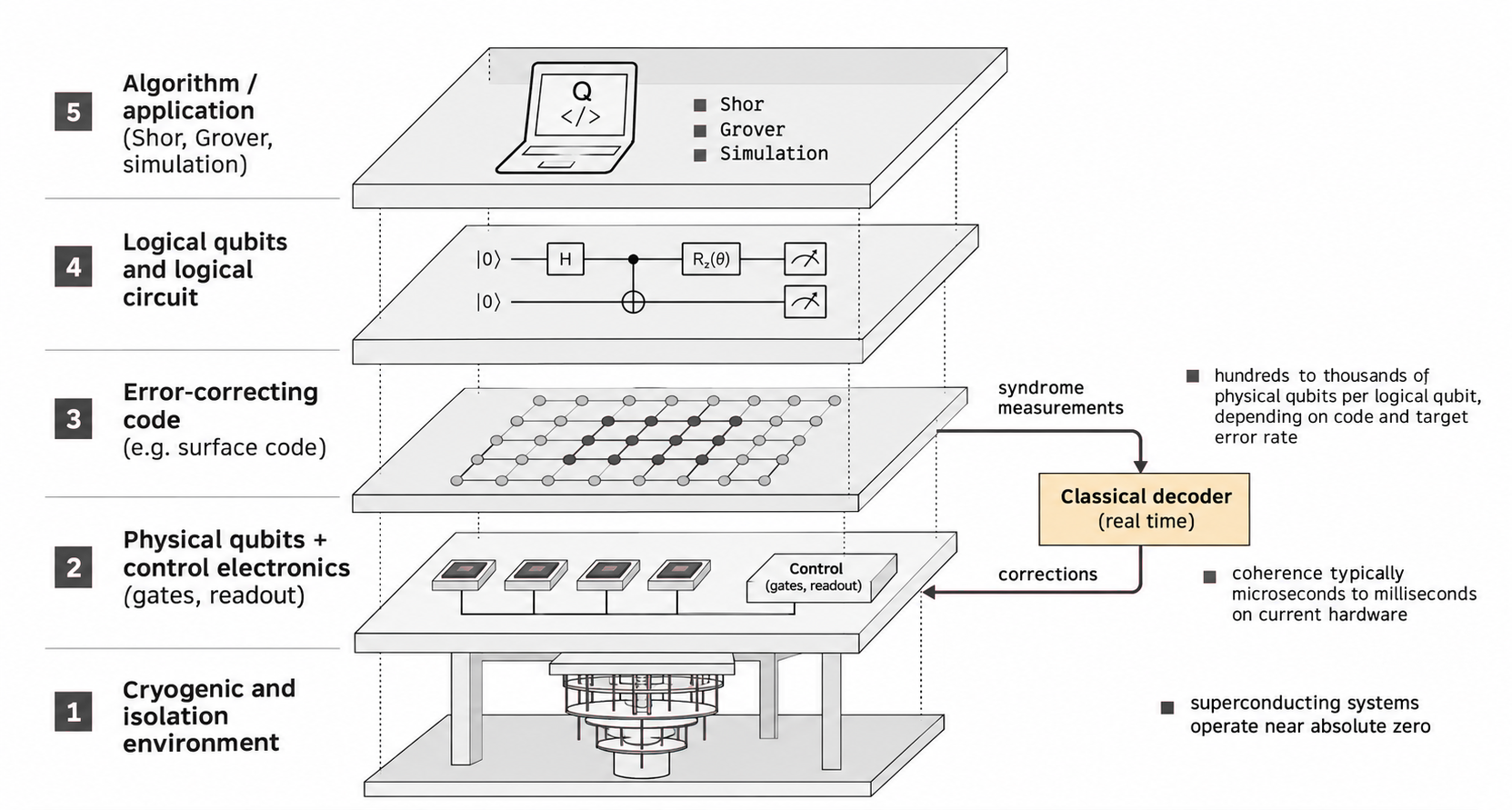
Noise. Heat, electromagnetic interference and vibration can destroy a quantum state. Superconducting systems run near absolute zero for this reason.
Coherence time. On most current hardware, qubits hold their state for microseconds to milliseconds.
Error correction is expensive. One reliable logical qubit takes hundreds to thousands of physical qubits, depending on the code and the target error rate.
Scale. According to the source article, the largest systems have a few thousand physical qubits. Verify against current vendor roadmaps before quoting a figure.
Several hardware approaches exist. Superconducting circuits, trapped ions and photonic systems are all being developed, with different trade-offs in coherence, speed and scalability.
Error Correction: What Willow Showed
Willow has 105 qubits. Google tested encoded-qubit grids of 3×3, 5×5 and 7×7 and reported that the error rate was cut in half at each step up in size. This is called operating “below threshold”: adding more physical qubits makes the logical qubit better, not worse. Google also reported real-time error correction on a superconducting system and a result “beyond breakeven,” where the encoded array lived longer than the individual physical qubits it was built from.
This is the property a scalable machine needs. It is not a demonstration of a useful computation. Google says that remains the next goal.
The Cryptography Case: Why Engineers Should Act Now
Breaking RSA-2048 with Shor’s algorithm needs a large, error-corrected machine, and that requirement has been falling. A 2019 estimate put it at about 20 million noisy physical qubits and roughly 8 hours of runtime. In May 2025, Craig Gidney published an estimate of fewer than 1 million noisy qubits and under a week of runtime.
The estimate keeps the same assumptions as the 2019 work: a square grid of qubits with nearest-neighbor connections, a uniform gate error rate of 0.1%, a surface-code cycle time of 1 microsecond, and a control-system reaction time of 10 microseconds. The reduction came from better algorithms and error-correction techniques, not hardware. The paper credits approximate residue arithmetic, yoked surface codes for idle logical qubits, and magic state cultivation. It also traded qubits for time: fewer qubits, longer runtime.
Two cautions:
- This is a resource estimate, not a working machine. No one has built a system anywhere near that size.
- Because algorithmic improvements are hard to predict, assuming the estimates have bottomed out is risky.
What to do about it:
NIST finalized its first post-quantum cryptography standards in August 2024: ML-KEM (FIPS 203) for key establishment, and ML-DSA (FIPS 204) and SLH-DSA (FIPS 205) for digital signatures. NIST’s transition guidance, IR 8547, sets out a migration timeline: today’s public-key algorithms such as RSA and elliptic-curve schemes are to be deprecated after 2030 and disallowed after 2035.
The urgency comes from “harvest now, decrypt later”: an adversary can record encrypted traffic today and decrypt it once a capable machine exists. Data that must stay confidential for many years is already in the window.
A Practical Checklist
These are our recommendations, not claims from the sources.
For everything else, watch the problem classes. Ask whether your bottleneck has the mathematical structure quantum algorithms exploit. The answer is usually no, and when it is yes, researchers will demonstrate the advantage before you need to act.
Limitations
- Qubit counts, error rates and resource estimates change quickly. Treat every number here as a snapshot.
- Willow’s benchmark has no known practical application, and the classical comparison is Google’s own estimate.
- The RSA-2048 figures are estimates under stated assumptions, not hardware that exists.
- This page does not cover quantum networking, quantum sensing, or annealing-based systems.