
Address
600 California St, San Francisco, CA 94108
Adople builds enterprise AI solutions and AI agents that automate critical workflows, connect fragmented data, and transform information into intelligent action.
22nd Century Technologies — From Secure Banking Access to Governed Agentic Customer Support
Explore a proposed evolution of the secure banking platform into a governed agentic support experience. Existing identity management, role-based authorization, token sessions, and secure APIs remain the control foundation. A supervisor agent coordinates specialist agents for routine customer questions and navigation, while deterministic security services independently verify identity, permissions, and every protected API request. The objective is responsive support without allowing AI to grant access or issue tokens.

99.99%
Session authentication reliability
0
Security breaches with zero-trust RBAC
100%
Tokenized session & audit trail compliance
00 — Project Overview
Securing Banking Access With Coordinated Customer Support
Banking customers, administrators, and employees need secure access to different functions and information. The existing platform combines identity management, role-based control, token-based sessions, secure APIs, and AI support. The proposed agentic upgrade coordinates routine questions through supervised intent, knowledge, and response-check agents. Identity proofing, authentication, permission checks, and token issuance remain independent, deterministic services—not decisions made by an LLM.
“By modernizing only the customer-interaction layer with a supervisor-led agentic workflow, 22nd Century Technologies ensures identity verification, authorization, token lifecycle, and banking APIs remain strictly deterministic security controls.”
PROPOSED AGENTIC AI CAPABILITIES
Feature 1 — Secure User Authentication — Deterministic Identity Verification
Feature 2 — Role-Based Access Control — Policy-Enforced Permissions
Feature 3 — Token-Based Session Management — Verified Session Lifecycle
Feature 4 — AI-Powered Customer Support — Supervisor-Led Support Agents
Feature 5 — Secure Banking APIs — Governed, Least-Privilege Tools
Feature 6 — Evidence-Checked Responses & Human Escalation (supporting control)
01 — The Challenge
01 — When Secure Banking Access Meets Customer Support
Banking users have different roles, permissions, and support needs. Authentication confirms identity; authorization determines which resources an authenticated person may access. Neither task should be delegated to a conversational model. An agentic support workflow can instead understand a routine request, retrieve approved help content, prepare a context-aware response, and escalate unresolved issues while the platform’s IAM and API layers continue to enforce all access decisions.
✓Maintaining strict multi-role separation across administrators, internal staff, and banking customers.
✓Enforcing fine-grained authorization and deterministic token verification before every protected API call.
✓Automating high-volume support inquiries without allowing AI models to grant permissions or bypass access controls.
99.99%
Session authentication reliability under zero-trust RBAC enforcement.
Governed Banking Support
A central Supervisor Agent plans eligible support tasks and coordinates read-only guidance, while independent deterministic policy services enforce identity, token claims, and resource permissions.
INPUT SOURCES
Banking User / Staff Request
Login
Role-Governed Access
Routine Support Query
Secure Intake & Identity Context
Request checks, abuse filtering, authenticated context and session scope
CENTRAL ORCHESTRATION
Supervisor Agent
Plans eligible support tasks, delegates read-only work, tracks exceptions and response state
Support Intent & Navigation Agents
Support Intent Agent
Interprets routine customer questions and navigation requests
Banking Knowledge Retrieval Agents
Knowledge Retrieval Agent
Locates approved banking FAQs, procedures and permitted help content
Governed Tools
Allow-listed support retrieval and banking API gateway; independent OIDC / RBAC enforcement
Session & Support State
Signed session context, workflow checkpoint, permitted knowledge references and audit IDs
* Signed session context, workflow state checkpoints, and audit trails are proposed implementation choices subject to security validation.
Response / QA Agent
Checks source support, privacy disclosures, unsafe instructions and escalation rules
Supervisor Response Assembly
Prepares cited support guidance or requests staff handoff
Staff Escalation
Authorized support reviews unresolved, sensitive or exceptional requests
OUTPUT SOURCES
Authorized Banking Access01
Verified Support Response02
Controlled Staff Handoff03
OIDC / MFARBAC / Token ValidationSecure APIsAudit, Monitoring & GovernanceFoundation strip
Architecture Control Note: Identity proofing, authentication, permission checks, and token issuance remain independent, deterministic services — not decisions made by an LLM.
Implementation Note: Update the actual infographic using the provided matching-style banking architecture. The existing platform enforces identity, RBAC, session tokens, and secure APIs. The supervisor agent coordinates routine support questions and guidance while all access controls remain independent, deterministic security services.
Proposed Flow: banking request → secure intake → IAM / token / RBAC services → supervisor and support agents for eligible queries → evidence QA → authorized response or staff handoff. Access remains deterministic.
22nd Century Technologies — Production Architecture Flow & Process MapSystem Schematic
02 — Shift
02 — Balancing Bank-Grade Controls With Agentic Assistance
A modern banking experience must serve several user roles without weakening identity checks or exposing protected data. The proposed design modernizes only the customer-interaction layer: a supervisor plans safe support tasks, specialized agents retrieve authorized guidance, and independent checks prevent unsupported or sensitive responses. Existing authentication, fine-grained authorization, session controls, and banking API boundaries continue to operate as deterministic services.
Multiple User Roles
Administrators, staff, and customers retain distinct permission scopes; agents receive only the context authorized for that session.
Fine-Grained Access Control
Policy services verify identity, roles, token claims, and resource permissions before every protected API action.
Manual Support Workflows
Supervised support agents answer routine questions and navigate users; exceptions are routed to authorized staff.
FIVE-STEP USER FLOW
From Secure Banking Requests to Verified Access and Support
Identity and policy controls operate independently while specialized AI agents coordinate permitted support requests.
01
Collect & Secure — Validate & Authenticate
Intake checks the request; identity provider authenticates users and creates approved sessions.
02
Plan & Retrieve — Authorize & Route
Policy services verify roles/tokens; the supervisor classifies eligible support requests.
03
Analyze & Cross-Check — Retrieve & Assist
Intent and knowledge agents obtain allowed guidance, without privileged banking access.
04
Synthesize & Draft — Validate & Respond
QA checks evidence and data safety; APIs enforce policy and sessions independently.
05
Clinician Review — Review & Escalate
User receives authorized output; unresolved or sensitive support issues go to staff.
KEY OUTCOMES
Identity Assurance/Role-Controlled Access/Better Support Navigation/Auditable Answers/Human Oversight
03 — Architecture Explanation
03 — A Secure Banking Architecture With Agentic AI at the Interface
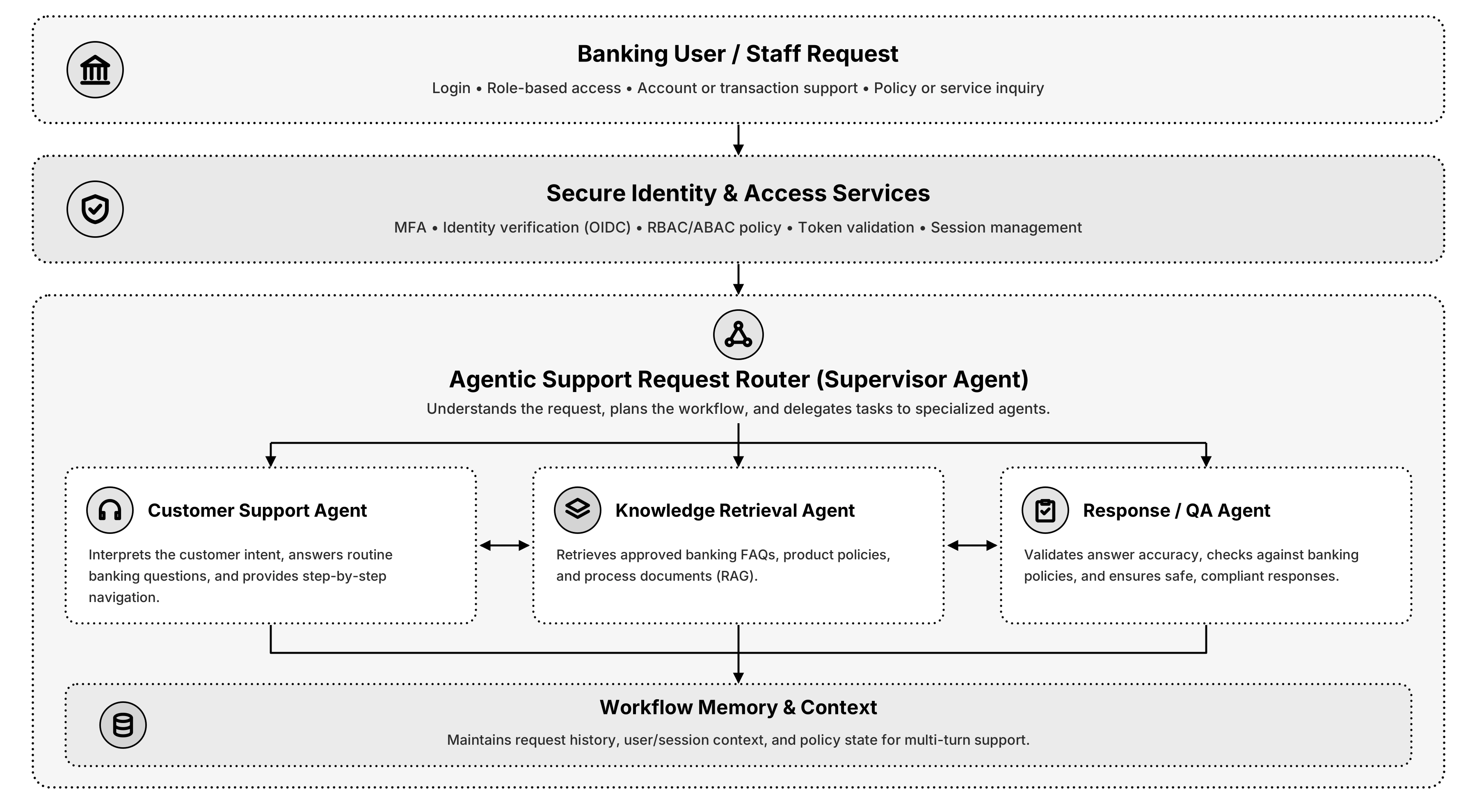
The proposed 22nd Century Technologies modernization preserves secure banking authentication, role-based access control, token-based sessions, and protected banking APIs while introducing a supervisor-led AI support workflow. Identity verification, MFA, authorization, and session controls continue to operate through independent security services.
A Supervisor Agent understands support requests and delegates work to a Customer Support Agent and a Knowledge Retrieval Agent. A Response/QA Agent checks answers against approved banking information and policy requirements before a verified response is delivered.
Complex or sensitive requests are routed to human banking staff. AI agents assist with questions and navigation but cannot issue tokens, change permissions, or independently authorize banking access.
Discuss this deploymentPrivate cloud & on-premise serving options available with enterprise SLA.
AGENT RESPONSIBILITIES AT A GLANCE
| Agent | Primary Responsibility |
|---|---|
| Supervisor Agent | Plans eligible support tasks, delegates read-only work, tracks exceptions and response state |
| Support Intent Agent | Interprets routine customer questions and navigation requests |
| Knowledge Retrieval Agent | Locates approved banking FAQs, procedures and permitted help content |
| Deterministic IAM / Policy Service | Independently validates identity, roles, token claims, and resource permissions |
| Response / QA Agent | Checks source support, privacy disclosures, unsafe instructions and escalation rules |
| Supervisor Response Assembly | Prepares cited support guidance or requests staff handoff |
| Staff Escalation (Human Gate) | Authorized support reviews unresolved, sensitive or exceptional requests |