Address
600 California St, San Francisco, CA 94108
Adople builds enterprise AI solutions and AI agents that automate critical workflows, connect fragmented data, and transform information into intelligent action.
BIJIB - Faster disease detection through automated AI analysis
Adople AI partnered with BIJIB to design a healthcare intelligence system that transforms complex patient data into structured, actionable clinical insights. The platform combines large language models, multi-agent AI, medical data processing, and computer vision to analyze healthcare information across multiple formats – helping clinicians identify disease risks and access relevant insights more efficiently.
Strategy
- Clinical Intelligence
- Disease Risk Detection
Design
- Multi-Agent AI
- Medical Data Analysis
Clients
BIJIB


Turning Patient Data Into Clinical Intelligence
Healthcare information is distributed across clinical reports, patient histories, laboratory data, imaging, and other structured and unstructured sources. Adople AI built a unified intelligence layer that processes these inputs and converts them into structured insights for clinical analysis and decision support.
Offer functionalities
- Clinical Data Analysis
- Disease Risk Detection
- Medical Document Intelligence
- Medical Image Analysis
- Multi-Agent Clinical Reasoning
01 When Patient Data Becomes Intelligence
Healthcare organizations generate large volumes of information across clinical reports, laboratory results, imaging, and patient histories. Much of this information exists in different formats, making it difficult to bring together and analyze consistently. BIJIB needed an intelligent system capable of processing these diverse data sources and turning them into meaningful clinical signals. The opportunity was to create a unified AI layer that could analyze patient information, identify potential disease risks, and surface relevant insights for clinical decision support.
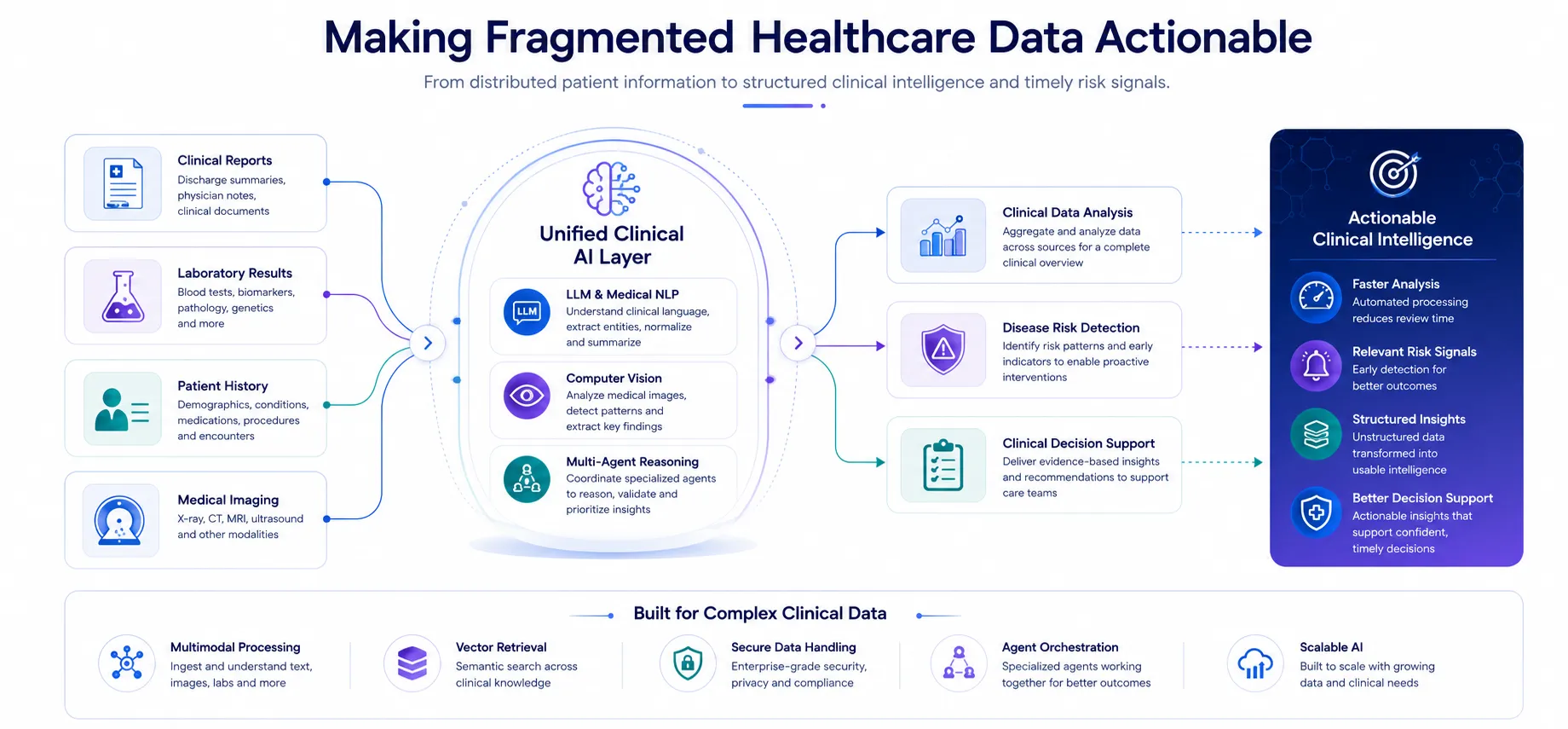
02 Making Fragmented Healthcare Data Actionable
The challenge was not simply collecting patient data. It was understanding information distributed across different formats and turning it into timely, usable clinical insight. BIJIB needed an AI system capable of processing complex healthcare data while supporting disease-risk identification and clinical decision-making. Three challenges shaped the system.
- Fragmented Clinical Data – Patient information was distributed across reports, histories, laboratory results, imaging, and other healthcare data sources.
- Complex Medical Information – Clinical information required AI systems capable of interpreting both structured and unstructured healthcare data.
- Timely Risk Identification – Clinicians needed relevant signals from large volumes of patient information without relying entirely on manual analysis.
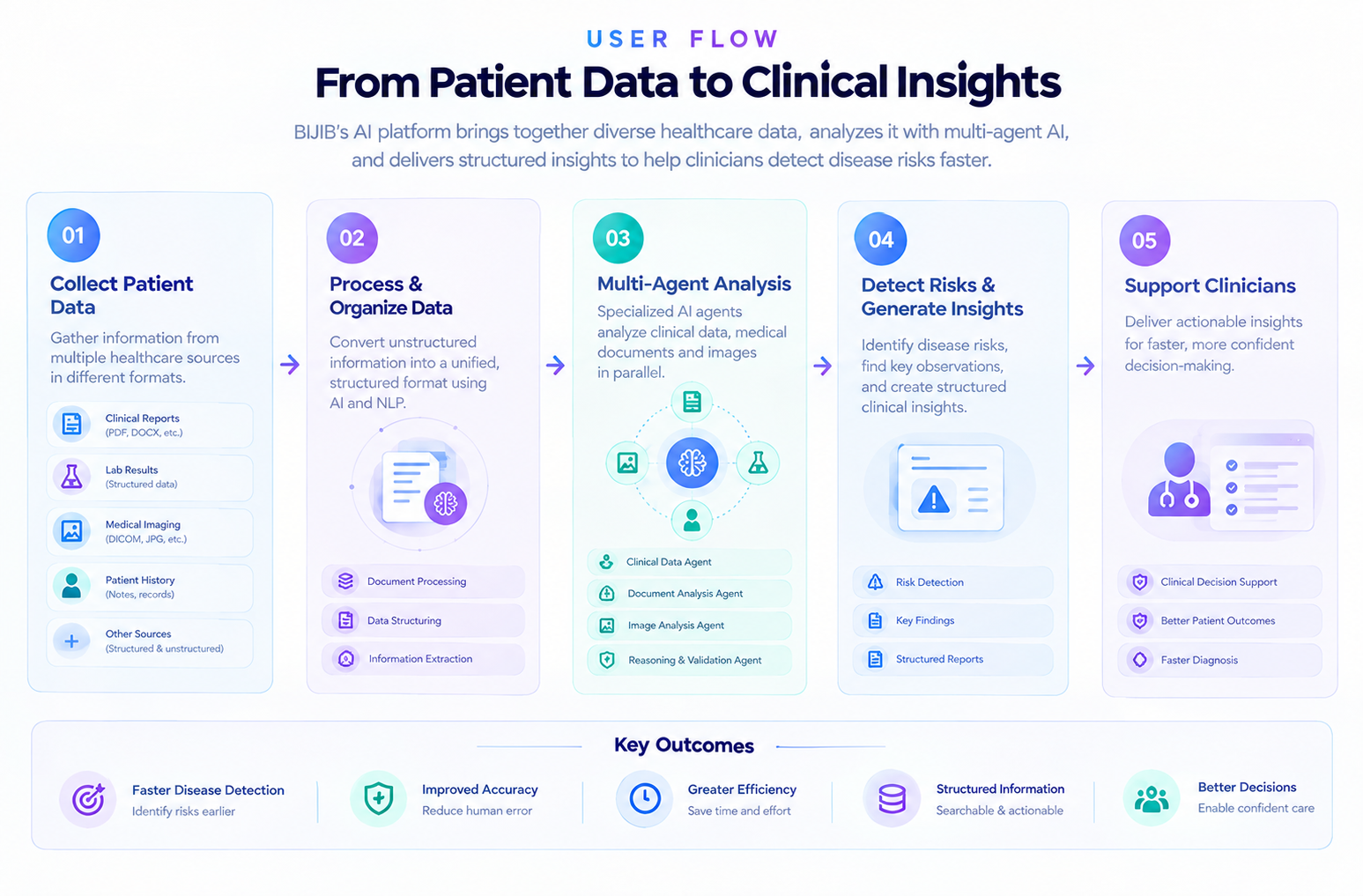
03 A Multi-Agent AI System Built Around Clinical Data
Adople AI designed and deployed a multi-agent healthcare intelligence system that brings clinical data processing, medical document analysis, and computer vision into a unified architecture. LLM-based systems analyze clinical documents and patient information, while computer vision models process relevant medical imaging. Multi-agent orchestration coordinates these capabilities across the workflow, with vector-based retrieval enabling the system to access relevant clinical information. The resulting intelligence layer helps identify disease-risk signals and delivers structured insights for faster clinical analysis and decision support.